
Advertisement
The check engine light comes on, and a parts store employee plugs a small reader into the port under your dashboard, free of charge, and tells you the code points to an oxygen sensor. You mention this to a repair shop, expecting a quick parts swap, and the shop says it will charge a diagnostic fee before recommending anything. It feels like paying twice for an answer you already have.
It isn’t, and understanding why can save you money in the long run. A trouble code is where a diagnosis begins, not where it ends. The diagnostic fee pays for a technician’s time, training and equipment to figure out what actually failed and why, so you replace the right part the first time instead of buying a series of guesses.
Advertisement
A Code Is a Clue, Not a Verdict
Modern vehicles monitor hundreds of conditions through sensors and computer modules. When a reading falls outside its expected range, the computer stores a trouble code and may turn on a warning light. The code identifies which circuit or system reported a problem, but it rarely names the part that needs replacing.
Take the oxygen sensor example. A code related to that sensor might mean the sensor has failed. It could also mean there is a vacuum leak letting in extra air, a leaking exhaust manifold, a wiring problem, a fuel delivery issue or a failing catalytic converter. Each possibility leads to a different repair with a very different cost. Replacing the sensor without testing might fix the problem or might do nothing at all.
Free code reads are a useful first step. They tell you roughly where the problem lives and whether it’s urgent, such as a flashing check engine light that signals a misfire serious enough to damage the catalytic converter. But the person reading the code at a parts counter typically isn’t a technician and isn’t testing anything.
Many common repair mistakes come from treating codes as instructions. Owners replace parts one after another based on a code, spend more than a proper diagnosis would have cost and still have the light on.
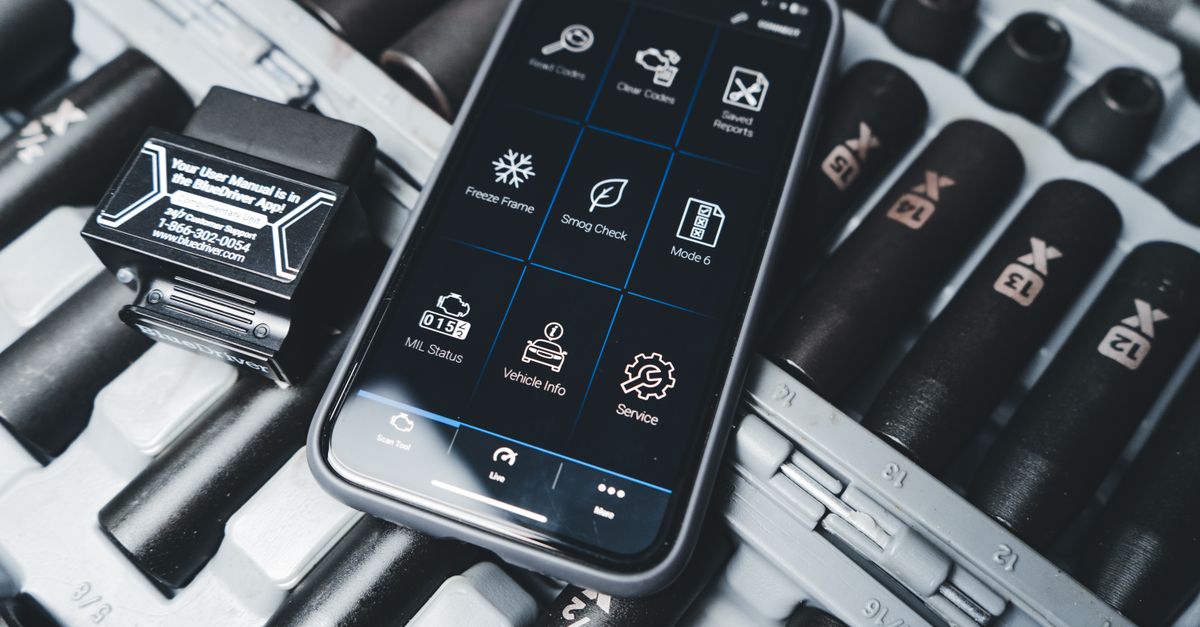
An inexpensive code reader of your own can still be worth keeping in the glove box. It lets you see whether a new warning is something minor, like an evaporative system code often triggered by a loose fuel cap, or something that deserves a prompt visit. Some readers connect to a phone and show basic live data. Just use the information to decide how urgently to see a professional and to describe the problem accurately, not as a shopping list for parts.
What the Fee Actually Pays For
A diagnostic fee covers far more than plugging in a scanner. It pays for the process of confirming the complaint, narrowing down possibilities and testing until the cause is clear.
- Technician time: skilled diagnosis is often slower and more demanding than routine repair work.
- Professional scan tools: far more capable than basic code readers, able to view live data, run system tests and communicate with many modules.
- Software and data subscriptions: shops pay ongoing fees for repair information, wiring diagrams and manufacturer procedures.
- Specialized equipment: smoke machines for leaks, oscilloscopes for electrical signals, pressure gauges for fuel and cooling systems.
- Road testing: many problems only appear under specific conditions, such as a certain speed or temperature.
- Training: keeping up with new vehicle systems requires continual education.
When a shop confirms that a sensor’s signal is actually wrong, checks the wiring to rule out a break, and verifies that the rest of the system is working, you’re paying for certainty. That certainty prevents the costliest outcome in car repair: paying for parts and labor that don’t fix the problem.
How Shops Structure the Charge
Diagnostic pricing varies between shops, and it helps to ask about the structure before you drop off the car. Many shops charge a flat fee that covers an initial block of diagnostic time, often up to one hour of labor. That’s usually enough for straightforward problems with clear symptoms.
For more complex issues, the shop may need additional time. A reputable shop will call you, explain what they’ve found so far and ask for approval before continuing. You should never discover several hours of diagnostic charges you didn’t authorize. At drop-off, you can set a limit and ask to be called before the shop exceeds it.
Some shops credit part or all of the diagnostic fee toward the repair if you have them do the work. Others charge it separately regardless. Neither approach is wrong, but it’s worth knowing in advance, especially if you plan to compare repair prices elsewhere afterward.
Dealerships and specialty shops often charge more for diagnosis than general independents, reflecting higher labor rates and brand-specific equipment. For complex electrical problems, driver-assistance systems or issues specific to newer models, that expertise may justify the difference.
Be thoughtful about offers of “free diagnosis.” A shop still has to pay its technicians and its equipment bills, so the cost is usually recovered somewhere else, often in the repair price or in a shop’s expectation that you’ll approve the work on the spot. Free checks can be perfectly fine for simple complaints, but for a complicated problem, a shop that charges openly for careful testing may give you a more reliable answer than one that has an incentive to reach a quick conclusion.
Why Some Problems Take Longer to Find
Not every diagnosis is quick. Intermittent problems are the hardest. A car that stalls once a week, a warning light that comes and goes, or a noise that appears only on cold mornings can be very difficult to reproduce in the shop. Technicians may need to drive the car several times, leave data recorders connected or wait for the right conditions.
Electrical faults are another category that consumes time. A single corroded connector or a chafed wire hidden inside a harness can create symptoms in several systems at once. Tracing it requires wiring diagrams, careful testing and sometimes removing trim panels to reach the wiring.
Multiple overlapping faults make things harder too. A vehicle with a vacuum leak and a weak fuel pump, for instance, might produce codes that point in confusing directions until each problem is isolated. Previous repairs done incorrectly, or aftermarket accessories like remote starters and alarms spliced into factory wiring, can also muddy the picture.
In these situations, extra diagnostic time is usually money well spent compared with guessing. Ask the shop to update you as they go so you understand the progress.
What You Should Get Back for the Money
A diagnostic fee should buy you information you can use, whether or not you have that shop do the repair. At minimum, ask for the findings in writing. That should include the codes retrieved, the tests performed, what the results showed and the technician’s conclusion about the cause.
The report should also include a recommended repair with an estimate, including parts and labor. If the technician is confident, they should say so. If there’s some uncertainty, for example if a repair addresses the most likely cause but further testing might be needed afterward, a good shop tells you that honestly rather than overpromising.
Ask to see the evidence if it’s practical: a photo of a cracked hose, a reading on a gauge, a scan tool graph showing a sensor signal dropping out. Those details help you understand the recommendation and let you compare repair quotes from other shops with confidence.
If a shop refuses to provide any details after charging a diagnostic fee, or says only “you need a new engine computer” with no explanation of how they reached that conclusion, that’s a reason to be cautious.
Helping the Technician Help You
You can often shorten diagnostic time, and lower the fee, by giving the shop good information. Describe the problem as specifically as you can. When did it start? Does it happen when the engine is cold, warm or both? At what speed? Only when turning, braking or accelerating? Does weather affect it? Is there a smell, a sound or a vibration?
Mention any recent work on the car, even if it seems unrelated, such as a new battery, an accessory installation or body repairs. Many problems start right after something else was disturbed.
Avoid clearing codes before you bring the car in. Disconnecting the battery or using a code reader to erase codes wipes out stored data that helps technicians see what happened and when. If the problem only appears under certain conditions, try to bring the car in when those conditions are likely, or offer to take the technician on a short drive to demonstrate it.
Keep notes over a few days if the symptom is intermittent. Patterns you record, such as “only after parking in the sun” or “only on the highway,” can save hours of testing.
When a Diagnostic Fee Is Money Well Spent
For simple, obvious problems, such as a flat tire, a burned-out bulb or brakes grinding from worn pads, a formal diagnostic fee may not be necessary. Many shops include a basic inspection in the cost of the repair. For anything involving warning lights, drivability issues, electrical symptoms or unusual noises, paying for a proper diagnosis is usually the least expensive path to a correct repair.
Before you approve, ask what the fee covers, whether it will be credited toward repairs and when they’ll call you if more time is needed. Afterward, ask for written findings. With that information, you can decide whether to proceed, get a second quote or wait on a non-urgent problem.
Keep in mind that a lit warning light can have consequences beyond the repair itself. Where emissions testing is part of registration renewal, which depends on your state or province and sometimes on your county or city, a car with an active check engine light or incomplete self-test monitors will usually fail. Diagnosing and fixing the problem well before the renewal date avoids a last-minute scramble and a second trip to the testing station.
A diagnostic fee buys you an answer. Compared with the cost of replacing parts that weren’t broken, a good answer is almost always the bargain.
